Contents
- The Pillars of a Modern Telecom AI Strategy
- Why AI Struggles in Telecom Without Real-World Context
- What Telecoms Need to Build a Practical AI Roadmap
- Conclusion: AI-Driven Telecom Strategies
- FAQ: CSP AI strategy
- Why do many telecom AI projects struggle to scale?
- How should telcos prioritize use cases in their AI roadmap?
- What role does telecom AI governance play in telecom AI strategy?
- Why is edge-based AI becoming more important for telecoms?
- Why does AI need a visual or multimodal AI telecom context to be effective in telecom?
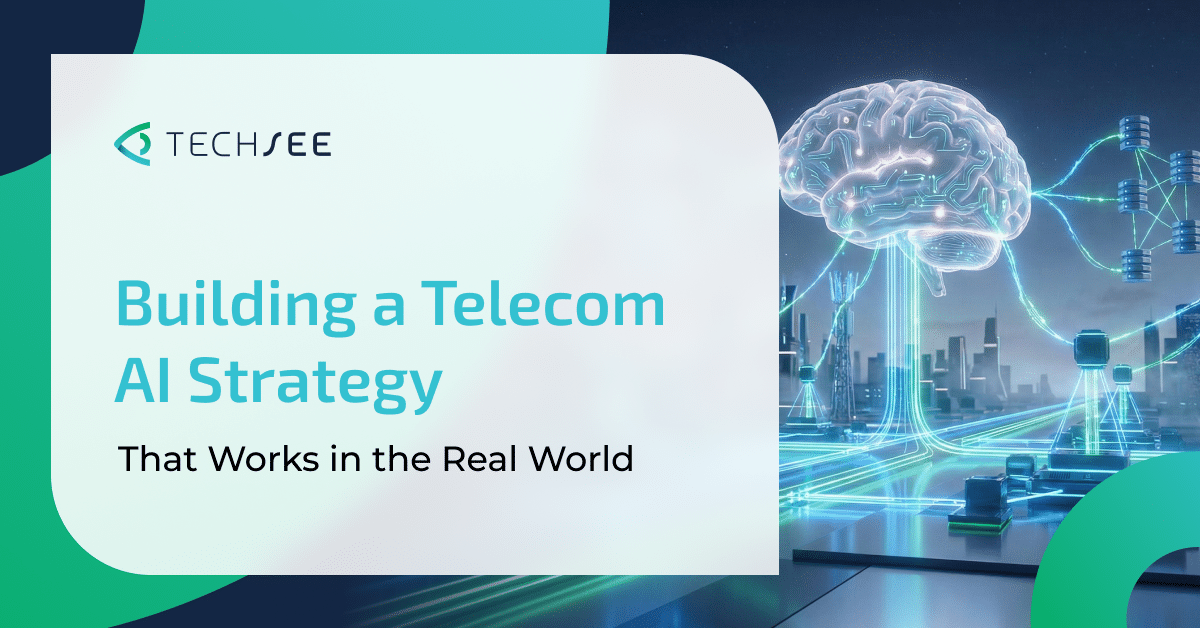
- Building a Telecom AI Strategy That Works in the Real World
Telecom executives face intense pressure to define an AI strategy that reduces OPEX, improves customer experience, and prepares the organization for the next wave of telecom automation. The challenge is not the lack of AI tools. The challenge is turning these tools into reliable, scalable outcomes. This is especially difficult in environments shaped by legacy systems, unpredictable home conditions, and complex operations.
Many AI initiatives promise quick transformation but struggle to deliver repeatable value once they meet the realities of telecom care, field operations, and home connectivity.
While analysts highlight trends such as agentic AI in telecom, edge intelligence, and sovereign models, the real shift in the industry is more fundamental. Telcos are beginning to treat AI not as a standalone technology layer but as an operating model change.
The most successful organizations focus on visibility, governance, data quality, and experience resolution, not just AI models. This difference determines whether AI becomes an efficiency engine or another expensive pilot that never scales.
The Pillars of a Modern Telecom AI Strategy
The first pillar is clarity on the problem Artificial Intelligence AI is expected to solve. For most consumer-focused telecoms, the cost drivers and retention risks sit in three places: the call center, the home environment, and field operations.
Improving margins or customer satisfaction requires AI systems that can accurately diagnose problems, understand customer context, and guide resolution rather than simply automating steps in isolation. The telcos that make progress start with experience-level outcomes instead of abstract AI goals.
The second pillar is the ability to operationalize AI across inconsistent systems. Telecom technology stacks contain a mix of modern cloud platforms, aging BSS/OSS components, and vendor-specific tools. AI must bridge these gaps.
This means investing in integration foundations, orchestration layers, and data pipelines that help AI understand what is happening across touchpoints. Without these foundations, agent assist, chatbots, or proactive telecom care systems generate surface-level value but fail to affect the underlying metrics that matter.
The third pillar involves governance, security, and explainability. Telecoms face regulatory and operational risks that make unmanaged AI deployments unacceptable. Gartner forecasts more AI-related security incidents as organizations adopt distributed models, but the broader issue is accountability.
Telcos need clear frameworks for how models are trained, how decisions are validated, and how human oversight is applied. This is especially important as agentic AI begins to automate multi-step processes in networks and in customer care. A fourth pillar emerging across the market is the rise of edge-based AI workloads. A fourth pillar emerging across the market is the rise of edge-based AI workloads.
As CPE and home devices become intelligent, AI at the edge telecom brings diagnostics closer to where experience problems originate. This enables earlier detection of service degradation. It also supports proactive action, reduces contact center noise, and improves stability in the home.
Running diagnostics, inference, or predictive models at the edge allows telcos to identify service degradation earlier and act proactively. This approach reduces noise in the contact center, decreases field visits, and improves stability in the home experience.
Why AI Struggles in Telecom Without Real-World Context
A recurring pattern in the market is that AI investments deliver less value than expected because they lack context about the customer’s physical environment.
Text-based assistants and predictive models may perform well in controlled scenarios but struggle when tasked with resolving real problems in the home, where WiFi conditions, device density, placement, and interference vary dramatically.
Contact center leaders report that many AI recommendations are accurate only in theory. Agents still need to ask customers clarifying questions when they cannot answer them.
Field technicians receive automated workflows that do not reflect what they encounter on-site. Models trained on idealized data cannot solve problems rooted in the physical setup. This gap is where most AI ROI erodes.
Multimodal and visual context closes this gap. When AI can see what the customer sees or interpret signals from the home environment, resolution accuracy increases sharply. This is where the industry is heading: combining large language models with vision, edge telemetry, and real-time diagnostics.
It is also where AI moves from “assistive” to genuinely “agentic,” because it begins to understand the problem space rather than just the conversation.
The telcos making the fastest progress are those that invest not only in models but in the resolution data that strengthens them. Visual evidence, home layout signals, WiFi telemetry, and field insights create the kind of rich context that makes agentic workflows reliable. AI systems that understand the environment become easier to trust, govern, and scale.
What Telecoms Need to Build a Practical AI Roadmap
A practical telecom AI roadmap begins with defining the experience outcomes the organization wants to change. Reducing repeat calls, improving home stability, lowering truck rolls, and increasing first-contact resolution all require AI that improves diagnosis, not just automation. Clear metrics create a direct link between AI initiatives and measurable business impact.
The next step is building a sequencing plan. Telcos that succeed with AI adopt a phased approach. They begin with narrow, contained use cases that simplify resolution for customers and agents, then expand toward proactive care and agentic workflows.
This avoids the trap of launching massive AI programs that stall under their own complexity. Early wins build trust and create momentum for more ambitious initiatives. Data readiness is another critical factor. Before scaling AI, telcos must ensure data from customers, networks, homes, and field operations is accessible and reliable.
This includes the often-overlooked categories of visual data, device-level telemetry, and misinformation patterns that lead to misdiagnosis. Governance structures must be in place from the start.
Telcos need review boards, audit trails, and monitoring systems that track how AI behaves in production. As decision-making shifts toward agentic workflows, human oversight remains essential. Trust is earned when leaders understand how AI reaches its conclusions and how exceptions are handled.
Finally, telcos must anchor their AI strategy in the home experience. The home is where churn begins, where support costs accumulate and where the brand’s reliability is judged. AI that cannot interpret or resolve issues inside the home will struggle to move the KPIs that matter. The roadmap should align network intelligence, customer care, and edge systems around stabilizing the home before broader automation.
Conclusion: AI-Driven Telecom Strategies
AI has the potential to reshape telecom operations, but only if strategies reflect the real environments where customer problems occur. Telcos should focus on outcomes, context, and governance, balancing innovation with the operational discipline required to scale safely.
The organizations leading the market are those building AI strategies around visibility, accuracy, and experience resolution rather than around models alone. As agentic AI evolves, advantage will favor telcos that can act within the complexity of the home.
FAQ: CSP AI strategy
Why do many telecom AI projects struggle to scale?
AI often performs well in controlled environments but fails when it encounters the complexity of real telecom operations. Without visibility into home conditions and device configurations, models cannot accurately diagnose issues. This limits their impact on reducing repeat calls and unnecessary truck rolls.
How should telcos prioritize use cases in their AI roadmap?
The most successful organizations begin with high-volume, high-friction journeys. These include aspects such as home connectivity issues or repeat-contact scenarios. These use cases provide faster returns because even modest improvements reduce OPEX and strengthen customer satisfaction. Early wins then support more advanced AI initiatives.
What role does telecom AI governance play in telecom AI strategy?
Governance ensures that AI behaves consistently, safely, and in compliance with regulatory expectations. It provides transparency into how AI makes decisions and gives leaders confidence in scaling agentic workflows. Strong governance frameworks reduce risk and create the foundation for long-term adoption.
Why is edge-based AI becoming more important for telecoms?
Running AI at the edge allows telecoms to detect and diagnose experience problems closer to the customer. This supports proactive care, reduces contact center volume and improves home stability by addressing issues before they escalate.
Why does AI need a visual or multimodal AI telecom context to be effective in telecom?
Most service issues originate from conditions inside the home that customers cannot describe accurately. Visual and multimodal signals give AI the environmental understanding it needs to recommend correct actions. This improves diagnosis, increases trust in AI recommendations and strengthens customer experience outcomes.
Building a Telecom AI Strategy That Works in the Real World
Telecom executives face intense pressure to define an AI strategy that reduces OPEX, improves customer experience and prepares the organization for the next wave of automation. The challenge is not the lack of AI tools. It is the difficulty of turning those tools into reliable, scalable outcomes in environments filled with legacy systems, unpredictable home conditions and intricate operational processes. Many AI initiatives promise quick transformation but struggle to deliver repeatable value once they meet the realities of telecom care, field operations and home connectivity.
While analysts highlight trends such as agentic AI, edge intelligence and sovereign models, the real shift in the industry is more fundamental. Telcos are beginning to treat AI not as a standalone technology layer but as an operating model change. The organizations having the most success with AI are the ones building strategies around visibility, governance, data quality and experience resolution, not just model capabilities. This difference determines whether AI becomes an efficiency engine or another expensive pilot that never scales.
The Pillars of a Modern Telecom AI Strategy
The first pillar is clarity on the problem AI is expected to solve. For most consumer-focused telecoms, the cost drivers and retention risks sit in three places: the call center, the home environment and field operations. Improving margins or customer satisfaction requires AI systems that can diagnose problems accurately, understand customer context and guide resolution rather than simply automating steps in isolation. The telcos that make progress start with experience-level outcomes instead of abstract AI goals.
The second pillar is the ability to operationalize AI across inconsistent systems. Telecom technology stacks contain a mix of modern cloud platforms, aging BSS/OSS components and vendor-specific tools. AI must bridge these gaps. This means investing in integration foundations, orchestration layers and data pipelines that help AI understand what is happening across touchpoints. Without these foundations, agent assist, chatbots or proactive care systems generate surface-level value but fail to affect the underlying metrics that matter.
The third pillar involves governance, security and explainability. Telecoms carry regulatory and operational risk that make unmanaged AI deployments unacceptable. Gartner forecasts more AI-related security incidents as organizations adopt distributed models, but the broader issue is accountability. Telcos need clear frameworks for how models are trained, how decisions are validated and how human oversight is applied. This is especially important as agentic AI begins to automate multi-step processes in networks and in customer care.
A fourth pillar emerging across the market is the rise of edge-based AI workloads. As CPE, gateways and home devices become more intelligent, AI can move closer to where experience problems originate. Running diagnostics, inference or predictive models at the edge allows telcos to identify service degradation earlier and act proactively. This approach reduces noise in the contact center, decreases field visits and improves stability in the home experience.
Why AI Struggles in Telecom Without Real-World Context
A recurring pattern in the market is that AI investments deliver less value than expected because they lack context about the customer’s physical environment. Text-based assistants and predictive models may perform well in controlled scenarios but struggle when asked to resolve real problems inside the home, where WiFi conditions, device density, placement and interference vary dramatically.
Contact center leaders report that many AI recommendations are accurate only in theory. Agents still need to ask customers clarifying questions they cannot answer. Field technicians receive automated workflows that do not reflect what they encounter onsite. Models trained on idealized data cannot solve problems rooted in physical setup. This gap is where most AI ROI erodes.
Multimodal and visual context closes this gap. When AI can see what the customer sees or interpret signals from the home environment, resolution accuracy increases sharply. This is where the industry is heading: combining large language models with vision, edge telemetry and real-time diagnostics. It is also where AI moves from “assistive” to genuinely “agentic,” because it begins to understand the problem space rather than just the conversation.
The telcos making the fastest progress are those that invest not only in models but in the resolution data that strengthens them. Visual evidence, home layout signals, WiFi telemetry and field insights create the kind of rich context that makes agentic workflows reliable. AI systems that understand the environment become easier to trust, govern and scale.
What Telecoms Need to Build a Practical AI Roadmap
A practical telecom AI roadmap begins with defining the experience outcomes the organization wants to change. Reducing repeat calls, improving home stability, lowering truck rolls and increasing first-contact resolution all require AI that improves diagnosis, not just automation. Clear metrics create a direct link between AI initiatives and measurable business impact.
The next step is building a sequencing plan. Telcos that succeed with AI adopt a phased approach. They begin with narrow, contained use cases that simplify resolution for customers and agents, then expand toward proactive care and agentic workflows. This avoids the trap of launching massive AI programs that stall under their own complexity. Early wins build trust and create momentum for more ambitious initiatives.
Data readiness is another critical factor. Before deploying AI at scale, telcos must ensure that data from customer interactions, network insights, home environments and field operations is accessible and clean enough to train and support models. This includes the often overlooked categories of visual data, device-level telemetry and misinformation patterns that cause misdiagnosis.
Governance structures must be in place from the start. Telcos need review boards, audit trails and monitoring systems that track how AI behaves in production. As decision-making shifts toward agentic workflows, human oversight remains essential. Trust is earned when leaders understand how AI reaches its conclusions and how exceptions are handled.
Finally, telcos must anchor their AI strategy in the home experience. The home is where churn begins, where support costs accumulate and where the brand’s reliability is judged. AI that cannot interpret or resolve issues inside the home will struggle to move the KPIs that matter. The roadmap should therefore align network intelligence, customer care and edge systems around stabilizing the home environment before expanding into broader automation goals.
Conclusion
AI has the potential to reshape telecom operations, but only if strategies reflect the real environments where customer problems occur. Telcos should focus on outcomes, context and governance, balancing innovation with the operational discipline required to scale safely. The organizations leading the market are those building AI strategies around visibility, accuracy and experience resolution rather than around models alone. As agentic AI evolves, the advantage will belong to the telcos that design AI systems capable of understanding and acting within the complexity of the home.
FAQ
Why do many telecom AI projects struggle to scale?
AI often performs well in controlled environments but fails when it encounters the complexity of real telecom operations. Without visibility into home conditions, device setups and field realities, models cannot diagnose issues accurately, which limits their impact on key metrics such as repeat calls or truck rolls.
How should telcos prioritize use cases in their AI roadmap?
The most successful organizations begin with high-volume, high-friction journeys such as home connectivity issues or repeat-contact scenarios. These use cases provide faster returns because even modest improvements reduce OPEX and strengthen customer satisfaction. Early wins then support more advanced AI initiatives.
What role does governance play in telecom AI strategy?
Governance ensures that AI behaves consistently, safely and in compliance with regulatory expectations. It provides transparency into how AI makes decisions and gives leaders confidence in scaling agentic workflows. Strong governance frameworks reduce risk and create the foundation for long-term adoption.
Why is edge-based AI becoming more important for telecoms?
Running AI at the edge allows telecoms to detect and diagnose experience problems closer to the customer. This supports proactive care, reduces contact center volume and improves home stability by addressing issues before they escalate.
Why does AI need visual or multimodal context to be effective in telecom?
Most service issues originate from conditions inside the home that customers cannot describe accurately. Visual and multimodal signals give AI the environmental understanding it needs to recommend correct actions. This improves diagnosis, increases trust in AI recommendations and strengthens customer experience outcomes.